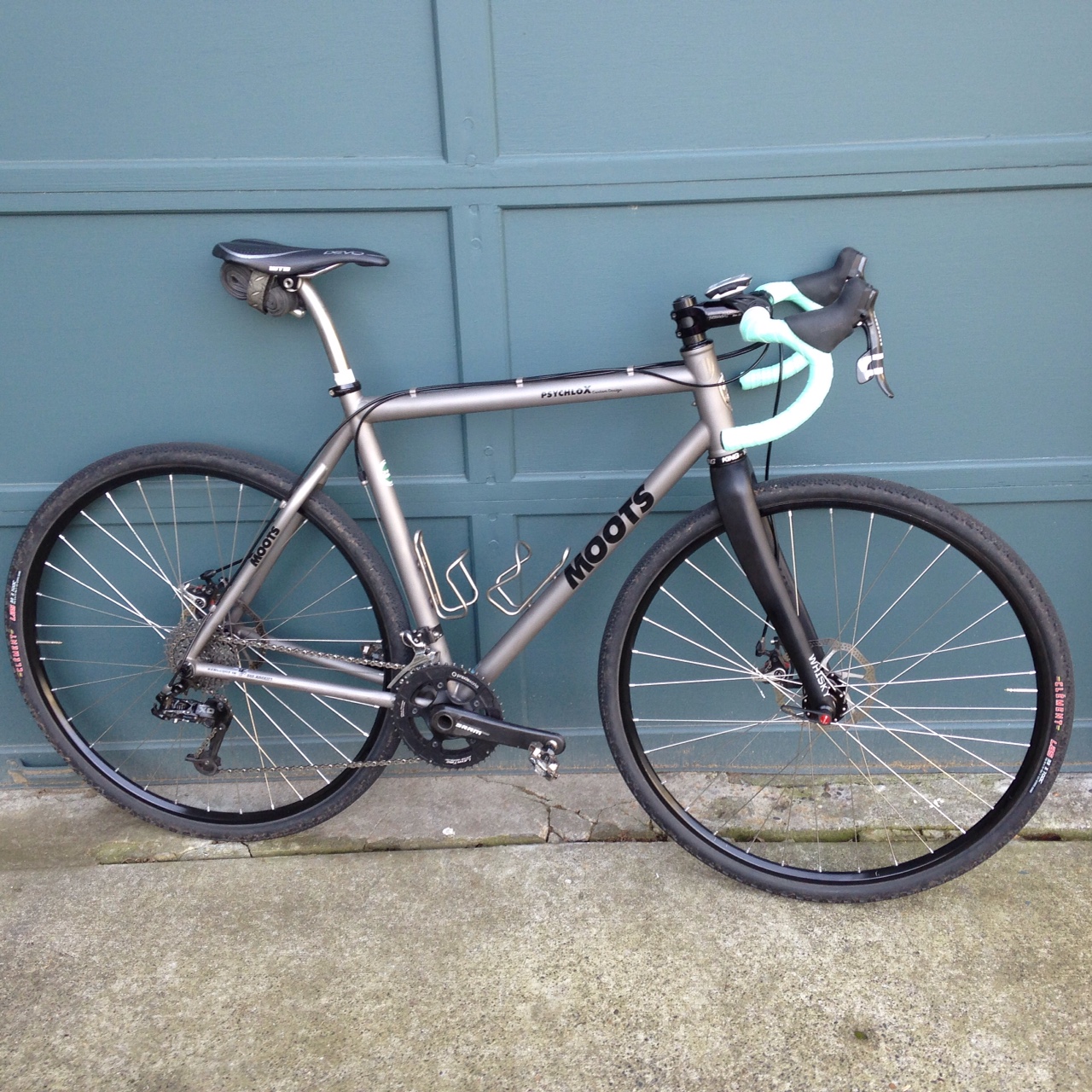
Moots MX Divide Tuning and the Fox Float RP23
The problem with riding other bikes is that there’s always something different about them that makes them desirable.
A few weeks ago I swung by the Skier Shop and took Dave’s Rocky Mountain Slayer for a ride in the Stowe town loops. With 165 mm of rear travel and 170 up front it’s a full-on All Mountain rig similar to the Cannondale Claymore I’d ridden at Highland so I expected similar trail worthiness.
After a few pedal strokes up the steep Skier Shop driveway it was easy to see that the Slayer made quick work of pedaling sections for a 32 lb sled. I’ll post a more in-depth ride review of the Slayer with some video footage, but specifically what struck me about that bike was how well Dave had setup the bike to stick to the trail and still pedal well.
Back at the shop we talked extensively about suspension setup and what specifically gave the bike such a platformy feel. Some of that was the properly tuned double barrel shock but there was some special attention given to the Marzocchi fork to keep it sitting high in its travel but still plush. While I’m not familiar with the nuances of the Marzocchi internals I could definitely pick up that there was certainly some special attention given to spring rates and oil levels.
On my next trip out on the Divide I was glad to push around a much lighter bike, but I couldn’t help but feel like it was wallowing a bit in the middle of the travel. With 100 mm of travel it should sit about 20-25% sagged in but no matter how much air pressure I ran it felt like it wanted to sit around 40-50%. I did some research and found that other riders had had similar experiences with the RP23- specifically bigger and more aggressive types; I guess I’m both. I hadn’t felt like it had been wallowing before and had not been bottoming out harshly so I blame riding a dialed setup for pointing out the issue.
Fox Racing Shox offers a Float tuning kit that is essentially a series of spacers that are designed to make the shock ride more progressively by making the air chamber smaller (you can get the kit directly from Fox or any of their distributors). I won’t go into details around how to install the kit as the Fox website and Pinkbike.com have great tutorials on it, but it’s a very quick process and swapping the spacers takes less than 5 minutes.
Here’s what the spacers look like.
With the set of three spacers (the biggest one is installed and not pictured) you get a small packet of Float Fluid to keep things running smoothly. Here’s what the tag looks like in case you’re interested.
Fox didn’t have a recommendation for which spacer a 185 lb rider should use on the Divide and recommended starting with the smallest and working up as necessary so I installed the small one and went for a ride. I felt a slight improvement but nothing legendary so I swapped it out for the medium one before hanging up the bike on the hook.
The Divide has been getting the attention because the RSL is still convalescing after being brutalized in last weekend’s mud slog. Specifically the rear wheel needed to have all of the heads- in drive side spokes replaced and since I was in Stowe already I left it with Dave for a stint in rehab. While I was there talked suspension again.
His recommendation was to go right for the large spacer rather than fiddling around trying to tune the middle one. Turns out his recommendation was right on- with the large spacer installed the bike was transformed into an all-out terrain consuming machine. It pedaled better. It tracked better, and in fast technical sections it skipped over things that buckled it before.
I’d been hesitant to use the Divide for courses that were more about pedaling (Pat’s Peak, Catamount Hill Side) than high speed technical sections (Hampshire 100, Catamount Eastern Cup). That’s changed. Now I’d consider it any situation where the terrain is challenging, obstacles are numerous or square-edged or the overall speed is relatively high.
There’s more tuning afoot for both bikes- check back for more details.
From the Saddle- Harwood Loop
6 Hours of Pat’s Peak- Race Report
I knew the forecast was for rain, but not that much rain.
The week leading up to the race I had some decent and varied training with some long road rides, free ride trail skill sessions, a Catamount race and some time in the woods on the race bike. It had been hot- very hot actually, and I was able to take advantage of the dry weather with some solid days of training. The rides were great but definitely took more out of me than I had anticipated.
Wednesday was Catamount, and based on the previous week’s miserable experience in the mud I decided to give the Maxxis Beaver mud tires a shot. They’ve been sitting in the basement unused for over a year but after feeling like the all condition Ikon wasn’t quite grippy enough in the prior week’s extreme mud I decided to run them since more rain was in the forecast. Of course we did get a ton of rain, but it all fell after Wednesday’s race so on a dry, hardpack day I was running super aggressive and super slow tires. I went into the race tired, and pushing around unnecessarily sluggish treads didn’t help and I dejectedly pulled the plug a lap early and headed to the car frustrated with my performance.
Even though that was a training race I was disappointed with myself after some strong days of training leading up to the event. I know I can handle endurance pace, but I always have a hard time with the short, high intensity stuff, and that wears on my confidence. Somehow I’d managed to get my back to start acting up again so on top of going slow I was hobbling around the next day with ice packs pressed on my lower back and hip flexors.
Feeling tired and sore with a dismal forecast meant that I had to engineer a plan for the race. It was supposed to be for training anyway, but that wasn’t enough. I thought about racing in baggy shorts just to mix it up a bit. Ultimately as I assembled my gear I came up with a motivational strategy that revolved around my all time favorite cycling fuel- Coke.
I’ve mentioned that in other posts, but what’s really funny is that I never drink Coke unless I’m on the bike. Never ever, yet somehow when I’m out on a ride there’s nothing I want more so I decided to use that to my advantage. The deal I made myself was simple- I needed to do at least 2 laps before I could quit, and if I did 3 laps I could have a Coke. In 2011 I did the same race in similar conditions so I had an idea of what to expect.
It was pretty clear this was going to be a very muddy day and having the right equipment on hand was going to be critical so I packed my usual race kit plus my mobile cleaning kit and 5 gallon bucket. The bike got one more run through and new set of batteries for the computer and cadence sensor (yes, I use cadence on the mountain bike). It looked like all the settings were fine and the clock looked right so I didn’t think any more about it.
Once I got to the venue on Saturday morning I was treated to a lengthy pre-race meeting which took up more time than I’d planned on. After that I got dressed, stashed my bottles in the drop area and headed out on my warm up. The bike felt good- responsive, quick and smooth. I checked the clock on my comuter- 10 minutes before start time as I spun around the far end of the parking lot.
Then all of a sudden I heard a voice on a megaphone counting down from 10- then an air horn- the race had started and I was still fucking around in the parking lot. In a full panic I ran up the stairs past the lodge carrying my bike. I frantically asked the officials if I could still start. At least I think it was an official- I just asked a woman in a black t-shirt standing by the timing tent and she said it was cool so I hopped on the bike and started going. At this point I’d spotted the whole field a solid 2-3 minute head start.
My plan was to start slow and ride consistently letting the conditions weed people out, and I certainly did get to start at the back with plenty of rabbits. As I pedaled through the first section I saw how slick it was- very slick in fact with every sharp edge and rock face spray painted orange for caution. My heart was racing from the nerves and as I tried to calm down and ride steady I could feel I was burning a ton of energy without really getting anywhere in the process.
In one of the many murky, deep puddles I heard a skip, then a horrifying crunching sound as the chain was dumped onto the spokes. As I tried to pull the chain back onto the cassette I saw that a spoke had been cut clean through and was dangling from the rim. Of course this was on my brand new hand build Hope Evo hubs with Notubes Crest rims and super flashy Sapim CX Ray spokes. Turns out the CX Rays aren’t very chain resistant so after being ridden a total of 30 miles I had to wind the broken spoke around its neighbor like a strand of bailing twine.
At this point I was really pissed. The handful of places I’d clawed back had all slipped away and I was back to dead last.
The course was slick, but as I pushed my way through some very deep puddles (one in particular submerged the whole caliper) and careened off of some rocks. There was one section in particular I remember from 2011- a nasty, rocky drop that I chickened out on every lap. It was slick just to walk down and I couldn’t even see a line. This time it was still in the course- and still nasty, but the issue was the slick and hobbly run-in rather than the drop itself.
Each lap had about 870 vertical feet out of climbing per lap and to be fair the course designers did a good job of not making it all up or all down hill, but regardless there were some steep exposed climbs. Believe it or not that’s where I reeled in riders every lap.
Once at the top there was a descent- not a super fast screaming descent, but a section that followed the fall line and in places literally was a murky trench with a creek running down through it. Most of the course got drier and improved throughout the day, but the creek got deeper and slipperier. I did reasonably well on that and was able to leverage my Highland skills to look further ahead, brake with one finger and let the bike float under me.
Usually I hit my stride about half to three quarters of the way into the race and this was no exception. Between laps 3 and 4 I caught 4 people in my category in rapid succession and as I was dialing in my lines I was starting to have some fun knowing where I could get away with a little extra speed and where I could keep off the brakes.
Heading into my fifth lap I stopped to get more water bottles and GU, plus another Coke for good measure. I also lubed my chain since it had been fully submerged and splashed more times than I could count.
Back out on the course on the first roll down the chain dumped off the cassette and sucked around the chainstay. I stopped to check it out and saw the short piece of the broken spoke by the hub had wedged itself into the back of the cassette. Shit. It had been skipping intermittently before, but now was not going to spin more than a full rotation without pushing the chain along.
Four and a half hours into a six hour race I was unable to coast and had to pull the plug. The tech tent was manned until 3 PM and it was now after 4 and although I carry tools with me a chain whip and cassette wrench aren’t usually in my pocket.
Shown above is the bike after being hosed off at the tech zone. Overall I had been starting to feel decent so I was pretty dejected to be unable to finish. With a full calendar of races still to come I stewed about what I needed to do to improve and how I would be ready for the Stewart Six Pack on June 30.
Any idea which socks those are?
6 Hours of Pat’s Peak is in the Rear View…
Find Your Ride at Highland, Part 2
“We should totally get you setup with a Find Your Ride” was about all it took.
Through the last two seasons I’ve done some work to improve my trail skills and I’ve referred to the bigger story as my gnarification project. Now I know that’s not a real word, but those that support the effort are going to think it’s rad no matter what it’s called and what started as a joke is actually gaining some traction around MTBVT hq.
Last winter when we sat around talking about plans for this season I mentioned that I wanted to do more skill sessions and keep building on what I did in 2012. Ryan and Jon both agreed that I should head down to Highland Mountain Bike Park and check out their all inclusive downhill experience- the FYR or Find Your Ride. While I can’t recall who actually said it there was quickly consensus- at least between the two of them- that I should check it out.
The package is pretty straightforward- a big hit rental bike, full face helmet, pads, a lift ticket and a lesson all wrapped up together to present a well-coordinated, legit downhill experience in a beginner-friendly environment. Cool.
After some quick emails I was booked for the Friday early session (usually there are two sessions per day but it’s recommended to call or email first to ensure availability). When I arrived I signed some forms and cracked some jokes about how mountain biking is a dangerous activity, and although I’m sure I’m not the first person to ever say that I got a kind chuckle from the staffers anyway.
With that out of the way I headed down to the shop to get setup with a bike, full face helmet and pads. The helmet and pads were nearly new. Admittedly this is the start of the season but I got the impression that the rental gear, and every other facet of the Highland experience, is taken seriously. Nothing was stored damp or thrown in a heap like the ice skates at Rockefeller Center. With some quick suspension tuning and tire pressure adjustment on the Cannondale Claymore I was equipped and out the door.
Did I mention the weather was questionable? It had rained for days before and the forecast was for even more rain throughout the day. Fortunately it was merely overcast as my instructor Chris “Green Tires” and I hit the flat grassy section to go over the basics. Right. As I bumbled around and figured out how to handle a bike with a wicked short top tube and a seriously slack head angle he went over the basics of body position, braking and cornering. And after 16 years riding exclusively clipped in the flat pedals totally threw me off.
As we headed up the lift we talked about the trails, what Highland is all about and why riding there is so special. Although I knew Highland was bike-focused, I didn’t realize they were the only downhill resort that was exclusively for bikes and without any winter activities. The trails are built for mountain biking with no long fall line descents, poorly placed water bars or rutted out mud holes. There were some sections built to mimic old school New England terrain- jagged rocks, slick roots and poor drainage, but they’re by far the exception and not the rule. On a wet day I counted a total of 5 puddles total across all of the trails we rode.
Off the lift and onto the trails I had my option for where to start and not knowing how serious things would get I opted for the basic green trails. As soon as we made it to the top of the trail and started down I could tell that the bike was far more capable than any of the super light race bikes in my stable. I quickly saw that the bike had to really be moving in order to turn or barrel through the hobbly sections, but with momentum and the right body position I could bomb through things with incredible ease. With confidence in the massive travel and strong brakes I was- by my standards- hauling ass down the mountain.
After I got a feel for the bike I was able to get more comfortable with the speed and more importantly looking further down the trail. Chris brought me down progressively more challenging terrain starting with Fancy Feast and Cat’s Paw then working our way to Happy Hour.
What seemed like just a couple runs quickly turned into a few hours as we ripped down the steep, manicured and remarkably dry terrain (truthfully Chris ripped and I got about as close as I get) while on the lift we talked about the bikes we wanted but couldn’t afford when we started riding.
My comfort level on the bike was increasing and so before we stopped for lunch we decided to hit Highland’s signature run- Hellion. After a short debate Chris assured me that I could handle it with the B-Line opt outs around the woolliest sections. As he hit every lip, kicker and sender I kept the wheels mostly on the ground. That run was by far the most fun I had all day.
Back at the lodge I had a remarkably tasty sandwich while the guys in the shop prepped a Transition TR-250 for me to take out.
For whatever reason I’ve had delusions of owning one of these for a couple years. Given that I didn’t even stretch the limits of the Claymore I felt a little bad about taking out the TR-250 as it was an even more suitable DH bike, but with it on offer it felt impolite not to take it out.
Greg, the shop manager, and Chris got the TR dialed in for me and even swapped in a heavier duty coil spring in the back. Having the bike setup appropriately was going to optimize my experience even though that meant I was largely taking them at their word as I had no idea how to set it up myself.
With the goal of taking one more run I rode the lift to the top with Eduardo, one of the long time regulars. We talked about how great the terrain was and how inaccessibly scary many other downhill areas in the North East were by comparison. Highland encourages progression and from their stair step approach to testing obstacles on a pump track to their camps and clinics they really make an effort to support riders who want to improve.
And as soon as I rolled down the ramp from the lift I knew I wanted a TR. While the Claymore was capable and almost 10 full pounds lighter the Transition had a stable, planted feel that begged to be pushed. Sadly I didn’t have enough gas in the tank to fully enjoy it. With that DH capability comes the need for increased speed to make the bike come alive and had neither the reflexes nor the strength to do it. On a dry day with more energy I’d love to go back to hit Eastern Hemlock, an old school New England technical trail on that bike to see what it, and I, can do.
Back at the shop I peeled off the helmet and pads which were notably muddier than when I picked them up, but nobody seemed to mind.
Even muddier lower limbs.
When it comes to lift assisted riding I’m far from an expert, but I’ve ridden enough on pedal accessed terrain to recognize a well designed and well maintained trail network. In short Highland runs a top flight organization and is well worth the trip especially if you’ve only ridden DH or Freeride trails on traditional New England terrain.
In part 3 of 3 I’ll talk about how I’ve taken the skills I learned in this session and applied them to my riding.
For more information visit http://highlandmountain.com/.
May Training Update & Race Prep
This spring, like most, has been up and down. What started out as late-breaking then very warm and dry season turned back into cool and rainy weather like we’d expect in April.
Last week got off to a decent enough start with a couple light days on the bike before Wednesday’s Catamount training race. After rounding up all of my gear and hoping for a dry course the skies opened up and it absolutely poured for almost an hour starting at about 3. Somehow that passed and then it lightened up enough for me to consider making the trek north, but a second passing shower ended any hopes of getting out on the course. Slightly dejected and frustrated a poured myself a drink and sat down on the couch to catch up on some television (I found out later that it had been canceled anyway so I made the right call).
Thursday was another strange day because it was mostly clear through the whole day before another deluge hit just after dark. I snuck in a dry 45 minute trail ride before my chiropractic appointment but had a very slow, treacherous drive home. It was raining so hard that I could only muster a safe speed around 40 mph and was very rapidly overtaking other vehicles at that pace.
Friday (as you may recall from my previous post) was my planned trip to Highland. With more rain in the forecast I was skeptical about hurtling myself down slick expert trails on an unfamiliar bike but fortunately my fears were unfounded. The trail builders at Highland have done a great job and with well constructed features and the natural advantage of New Hampshire’s sandy soil the trails were in great shape. With the exception of some slick roots and rocks my experience was otherwise unaffected by the weather. I’ll have a formal, in-depth write-up ready after I get some of the photos back, but the short version is that I had a great time. Highland runs a first-class operation top-to-bottom and with some quality instruction from their head camp instructor Chris Chmliewski I was bombing down the steeps on a Cannondale Claymore. Over the course of a few runs I talked myself into demoing a Transition TR 250 which they had in the fleet. That was a good and bad thing. It was good because I realized those bikes are awesome and my 250 lust is well founded. It was bad because I re-aggravated my slow-healing back injury and stacked my ribs on the handlebar in a stupid, low speed bobble. Turns out big bikes need to be ridden fast, and at normal XC pick your way through pace they’re sluggish and unwieldy. That’s not the bike’s fault, but as I was getting more fatigued after 3+ hours of DH runs I was worn out and while I lost precision I also started slipping into XC mode and learned very quickly that what works on a steep 4″ bike doesn’t work on low, slack 7″ travel monster.
So stoked but semi-hobbled I sat at home with Carrie drowning my sorrows in bourbon while tag teaming junk food. Not normal for us to say the least, but given the circumstances and the high risk of flooding it became a very necessary coping mechanism. Fortunately we escaped the torrents unscathed and both our home and our town were unaffected.
When the rains passed and things dried out on Monday I was able to sneak out for a 50 mile road ride. 6 Hours of Pat’s Peak is 2 weeks so I need to keep up my mileage if I’m going to be competitive.
This week it’s back to training and getting as lean possible before next weekend. Jason is putting the finishing touches on my new race wheels so I’m hoping to get some time on them this weekend. My bags are packed and I’m ready to contest my first race of the season at Catamount tonight and hopefully my back will cooperate.
I’ll let you know how it goes.
Find Your Ride at Highland, Part 1
Friday I’m heading down to participate in one of Highland Mountain Bike Park’s Find Your Ride sessions- and I’m completely stoked about it.
This session is part of an ongoing series I’ve dubbed my “gnarification” with the goal being increased trail skill and confidence. Endurance races aren’t usually super technical, but parts of them can be and being able to ride those sections quickly, safely and with little effort is what pays dividends over a 6+ hour event.
But beyond the simple arithmetic of nanoseconds per mile is the fact that riding fast and aggressively is fun. While I’ve made some improvements in my skills over the last couple seasons I still have plenty of room to grow and getting some good instruction is the key to that. I’ve even toyed with the idea of getting a full-on DH bike even though the baggy shorts I bought last season have been worn out on the trail about 4 times total.
I’ve never been to Highland, but I’ve heard great things. In the 17 years I’ve been around bikes I’ve done exactly one downhill run- I was in college riding a friend’s 14″ steel Specialized Stumpjumper hardtail setup “dual slalom style”. And I think I rode it to the top of the run before throwing the chain halfway down and running across the line. Pretty sure I did that race in jeans and a borrowed full face helmet.
I’m expecting to feel a little humiliated by punk ass kids half my age, kids who have no idea who John Tomac is and have probably never seen a GTI with less than 200 horsepower. But more than that I’m looking forward to pushing my boundaries and going into a segment of the sport where I’ve never truly been comfortable.
I’ll let you know how it goes.
Review- Maxxis Aspen
When I look at the number of times I’ve used the Maxxis Aspen I think about how I could get more out of it.
The 29 x 2.1 size weighs a hair over 500 grams and fully measures its claimed width, so for all of those stats what’s the catch? 500 grams is light, especially for a 29er tire, so really that means that it’s built for racing- plain and simple. The treads are a basic-looking ridge design with some trapezoidal arrowhead-looking blocks to keep it interesting (the overall pattern looks like a minimal version of the trail-centric Maxxis Ardent). The casing shape is fairly square so a wide contact patch puts a surprising amount of tread in contact with the ground.
Overall tread height it pretty minimal to keep rolling resistance down, but the real story here is the cornering knobs. The tire itself is designed like any good race tire to roll fast in a straight line and even with a wide contact patch the tire does just that. As the tire is leaned over in loose sand or gravel it can skate around for a split second before the side knobs dig in to provide cornering stability. On a few occasions I started to slide through some sandy corners and every time the tire slipped until the side knobs started to bite- and no further.
The light weight and fast rolling come at a cost and that is overall volume; in order to make the casing tough enough to withstand normal trail conditions it has to smaller in circumference to keep the weight down. As with any low tread tire most of the weight is in the casing since the minimal treads provide little in the way of protection from sharp objects. For this reason I prefer the Aspen to the Ikon in places where sidewall cuts and damage are a concern.
This lack of volume can be seen on the trail when hitting square-edged rocks and tall roots at speed. While the Aspen won’t unceremoniously toss you over the bars when you get off of your line it will not offer the reassuring centering bounce of a higher volume tire.
The Aspen and Ikon are similar options that can often be used interchangeably and Maxxis sponsored pro riders will often be split between the two models at any given race. The difference is that the Ikon has a taller tread, squarer profile and higher volume that does well when the ground is soft. The Ikon is by no means a slow rolling tire, but the Aspen is appreciably faster. On very firm ground where the Ikon’s taller knobs can squirm the Aspen is more solid as the barred tread is much shorter. The Aspen is also less expensive and wears longer. Many racers will run the Aspen almost exclusively, but with my skillset I tend to prefer the Ikon. If there’s any doubt about what conditions I may encounter the Ikon is more predictable and versatile in soft terrain since it can handle all but the worst mud.
Overall the Aspen is a great tire and it is far more versatile than other fast rolling dry condition options like the Small Block 8. In the sandy washout anecdote mentioned above I would have surely crashed had I been riding the SB8 instead of the Aspen since the SB8 has no cornering knobs to speak of. The Aspen also outperforms its counterparts in light mud since its flat-ish profile means a stable transition from edge to edge, and where it does slip it quickly and predictably catches hold again as soon as the cornering lugs hook up.
For more information visit www.maxxis.com.
Pro-35 T-Shirts, 2013 Edition
Although I haven’t cranked out a ton of wordy posts recently I have been very busy riding, training and working on blog-related materials.
I’ve mentioned the Pro-35 kit which will be rolling through production shortly, but before those land I’ll have the new 2013 version of the Pro-35 t-shirt. Last year’s GTI design was a hit so with some subtle tweaks I’m running the GTI again for this round.
Here’s what the art will look like.
Some of my developer friends seem to think I can get paypal enabled for folks that would like to purchase one of these suckers, so I may get that running before too long as well.
In the meantime if you’re interested in one of these just holler via email, comment, or smoke signal.